Mountain View, CA · Google · X, the Moonshot Factory

Does the score in the lab
hold up in the world?

I'm Yashica. I build and evaluate learned models of weather, robots and reasoning — forecasts at X, perception and LLM systems at Google, and policies on my own SO-101 arm — and I keep asking the same question of each.

hover the underlined words · move your cursor: the arm solves inverse kinematics

0papers in 2026
Nature (in review) · NeurIPS workshops
0better extreme-rain Brier skill
Laxmi vs. ECMWF AIFS-CRPS
0robot datasets labelled
LeRobot convention audit
0GPA at IIT Kharagpur
top 0.7% of 950

01 · Research

One question, four testbeds

A benchmark number is a claim about the world. Each project below tests that claim somewhere different: in the atmosphere, in the data robots learn from, and in a proof. Click a node.

physical world ↑↓ symbolic world lab score≟ world score WeatherLaxmi · Xdoes skill survive extremes? ConvectionCliMA · Stanfordhow far ahead is knowable? Robot dataLeRobot Hubdo the units agree? ReasoningProofs · NeurIPSis “certified” right?
atmosphere robots reasoning

X, the Moonshot Factory · Project Pythia · 2026–now

in review · Nature

Laxmi: a weather model trained on what satellites saw

Most AI weather models learn precipitation from reanalysis, which is itself a model. Laxmi keeps the ECMWF AIFS-CRPS architecture and changes the training target to IMERG satellite precipitation. The result is a better-calibrated 50-member ensemble, with the largest gains where it matters — heavy rain.

  • Graph-transformer, 0.25°, trained with the open-source Anemoi framework
  • 3-stage autoregressive rollout up to 12 steps on 128 A100s
  • Alongside: S2S foundation models at 4-week lead, and regional downscaling for Australia, Kenya and Brazil with Mixture-of-Experts blending

J. F. Schmitt, B. Delorme, R. C. King, Y. Patodia, T. Schneider, A. Sheshadri, R. Jain. Improving global precipitation forecasts with an AI weather model trained on satellite observations. Submitted to Nature. arXiv:2609.03210 ↗

Fig. 1 — what changes in training
atmosphericstate t graph transformerAIFS-CRPS architecture× 12 rollout steps 50members IMERG satellite rain ← new training target (CRPS loss)
Fig. 2 — gains over AIFS-CRPS (higher is better)

Spread–skill ratio (1.0 = perfectly calibrated ensemble)

00.51.0 AIFS-CRPS 0.50 Laxmi 0.83

Independent research · SO-101 · Sept 2026–now

growing · code public

Same name, different units

I own an SO-101 arm and train imitation-learning policies on it, so I went looking at the community data those policies learn from. SO-arm joint values on the Hugging Face Hub follow three incompatible conventions, because the recording software changed twice while keeping the feature names. Nothing in the metadata says which one a dataset uses.

  • Servo positions are integer encoder ticks, so each convention lands on a different numeric grid — the tool tests a dataset's min/max against each grid
  • Reads only metadata (info.json, stats.json): no video, no GPU
  • Curated training mixes combine conventions: community_dataset_v3 is ~78% one and ~22% another by frames

github.com/yashica-patodia/lerobot-convention-audit ↗ · labels for 35,674 single-arm datasets

Fig. 3 — three conventions, one feature name
A · legacy degreesbefore Jun 2025 · zero = calibration pose B · range-normalizedJun 2025 → v0.4.3 · −100…100, clamped C · midpoint degreesv0.4.4+ · zero = range midpoint

grid spacing (schematic): A = 360/4096°, C = 360/8190°, B = a per-arm step that matches neither

Fig. 4 — share of new-API datasets recorded in degrees
0%100% PR #2968 → v0.4.4 (Feb 2026) ~14% / month ~89% / month Jun 2025 (PR #777: new API)

Independent research · with Prof. Aditi Sheshadri (Stanford) & CliMA/Caltech · 2026–now

growing · experiments

How far ahead can a storm be known?

Using CliMA's ClimaAtmos (Julia) on Stanford's Sherlock A100 cluster, I measure the intrinsic predictability of tropical convection: perturb the atmosphere by one part in a million and watch the twin runs drift apart.

  • Errors double every ~1.3 h; storm-scale fields fully decorrelate within ~13–21 h
  • Errors originate at 6–11 km scales (2D-FFT decomposition); moisture keeps large-scale memory ~10 h longer
  • Root-caused non-reproducible GPU runs to unseeded random cloud sampling in the RRTMGP radiation code, which cut predictability by 2–4 h; fixed with bit-for-bit tests
  • Scaled a 1536 km rotating tropical-cyclone study to 8 A100s per run (1.9× speed-up)
Fig. 5 — try it: drag time forward on a 10⁻⁶ perturbation
×1
decorrelated13–21 h 10⁻⁶1 0 h132124 h doubling every ~1.3 h - - unseeded cloud sampling (bug):saturates 2–4 h early

Independent research · with A. Gupta & M. Saldivar · 2026

accepted · NeurIPS WS

When is proof-step verification worth its cost?

A certify-or-decline verifier reads an LLM's solution the way a grader reads an exam: formalize it, check each step with typed LLM judges, try a bounded repair, and decline if the argument still fails. I measured when that is worth it with open-weight Qwen3, gpt-oss-20b and Phi-4 stacks on GPQA, AIME-2025 and MATH-500.

  • Precision rises sharply but coverage falls: the verifier answers only 35% (GPQA) and 21% (AIME) of attempts
  • Near ceiling (MATH-500) the gain shrinks to ≤5 pp
  • A token-matched self-consistency baseline is statistically comparable (82.9% vs. 87.6%)

A. Gupta, Y. Patodia, M. Saldivar. When Is Proof-Step Verification Worth Its Cost? NeurIPS 2026 Workshops on MATH-AI and Verify-Agents. code ↗

Fig. 6 — the certify-or-decline loop
LLMsolution formalizer typed LLMjudges bounded repair loop certify ✓ decline ∅
Fig. 7 — precision gained vs. share of attempts answered
0%50%100%0+50 pp coverage (attempts answered) GPQA+31 pp precision, answers 35% AIME-2025+46 pp precision, answers 21% MATH-500 (near ceiling)gain ≤ 5 pp

Each point is one benchmark. The verifier buys precision by declining most attempts — useful when a wrong answer costs more than no answer.

52 of 88 failures came from invalid proof construction

02 · Path

Seven years, four lanes

Read it top to bottom. The colour and icon on each card tell you which lane it belongs to: study, industry, research or community.

03 · Engineering at Google

Systems that ship to millions

Software Engineer, AI Systems & Infrastructure — summers 2021 and 2022, full-time since July 2023, promoted early. Since January 2026, a 20% role at X.

VLM

Nest AI Perception

Video pipeline and VLM-based event detection for Nest camera clips; face, pose, expression and active-speaker models that curate AI "magic moments" and daily digests, with Google Research.

vision-language · video · perception

batch LLM

Bulk LLM offline inference

Distributed batch LLM inference over millions of advertiser landing pages, staging structured promotion annotations in Spanner; C++ Dagger graphs that reconcile LLM outputs with live Ads serving state.

LLM infra · Spanner · C++

Store-sales delay modeling

A two-stage bidding architecture — deep representation learning plus aggregate calibration — with delay heads for conversions that are reported late (right-censored upload lag).

TensorFlow · Ads · censoring

Earlier: MITACS / UBC

PLQList, an object-oriented MATLAB package computing closed-form Legendre–Fenchel conjugates of bivariate piecewise linear-quadratic functions, merged into the lab's CCA library (with Prof. Yves Lucet, 2022).

convex analysis · MATLAB

Before all that: undergrad builds

    04 · Community

    Rooms I've helped open
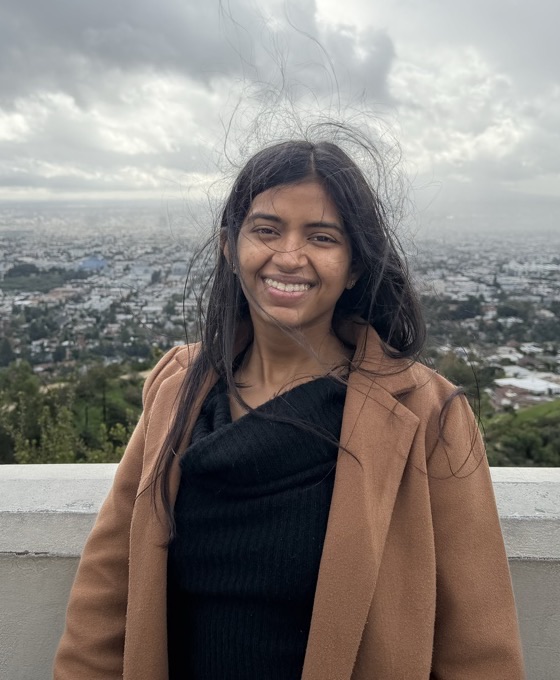
    Yashica Patodia at Griffith Observatory, Los Angeles, under a cloudy sky
    Griffith Observatory — a good sky for someone who works on rain.

    I care about technology that closes the distance between a line of code and a person's day — and about who gets to be in the room building it. At IIT Kharagpur I helped run the open-source society, started a Feeding India chapter, and co-created the institute's first apex women's council. At Google I've kept going.

    • 0students onboarded to open source via Kharagpur Winter of Code, as Executive Head of KOSS
    • 0raised by the first student Feeding India chapter, which I founded; the model was replicated at 5+ IITs
    • 0students led as Development Team Captain to the Inter-IIT Tech 11.0 overall gold
    • 0GitHub Campus Experts chosen globally from 10,000+ applicants; I was one

    Selected honors

    • 2024OneBLR Citizenship Award — 1 of 10 among 8,000 Googlers in Bangalore
    • 2022Nutanix Advancing Women in Technology Scholarship — 1 of 11 globally
    • 2022MITACS Globalink Research Internship — fully funded, ~10% selection
    • 2022Harvard WECode Technology Fellow · Grace Hopper Celebration Scholar
    • 2022Google Code Jam to I/O for Women — global rank 26 · Google Kickstart — global rank 43 of 13,000+
    • 2022Smart India Hackathon — rank 2 of 5,000+ teams
    • 2019KVPY Fellowship — top 0.5%
    • 2017–19All-India rank 3 (ICSE) and rank 5 (ISC) in national board exams

    Say hello.

    I'm happy to talk about robot evaluation, weather and climate models, or getting more women into the room.

    © 2026 Yashica Patodia · yashicap.me